
Excerpt:Sixty Hours 'til Sunset
Chapter One
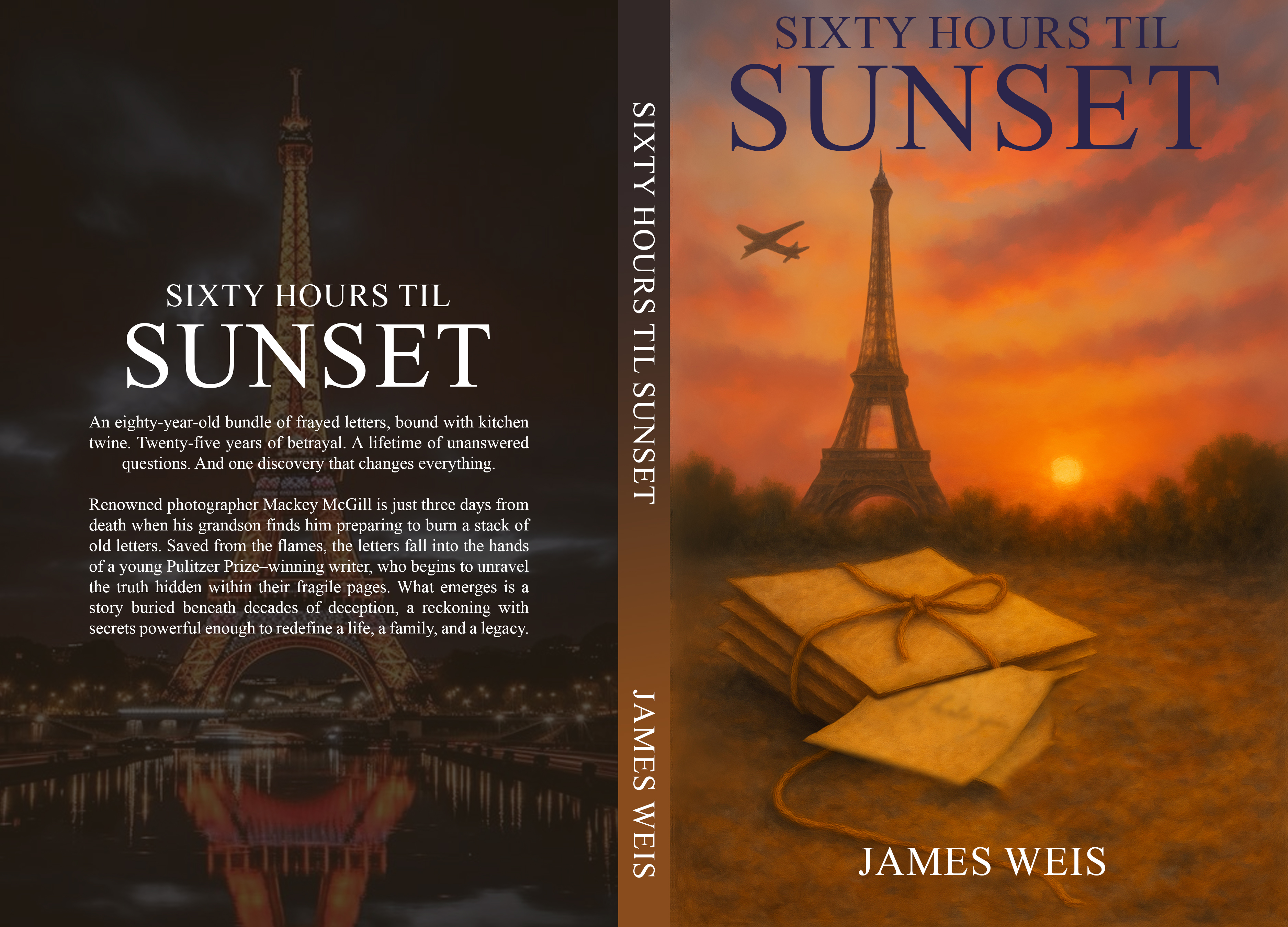
Sixty Hours 'til Sunset
Sixty Hours 'til Sunset
An eighty-year-old bundle of frayed letters tied with kitchen twine. Twenty-five years of betrayal. One discovery that changes everything.
In Paris in 2043, legendary fashion photographer Mackey McGill has sixty hours left to live. At ninety-seven, he has made his final decision and gathered those closest to him. But there is one thing he cannot bear to leave behind: a stack of letters that could unravel the story he has told about his life.
He intends to burn them. His grandson saves them from the flames.
More from Sixty Hours 'til Sunset
A view from the far side of a makeup brush.
From 1980 through 1994, I was a renowned fashion makeup and hair artist who took a captivating journey through the 80's and 90's countercultural epochs of high fashion, where I got an intimate glimpse into the glamorous but tumultuous world of the industry. While others spiraled into expensive rehabs, I took notes. After two decades of journaling, I have sharpened my pencil to take you to the darker and brighter sides of the radical wave of the hedonistic Sex, Drug, and Rock and Roll era of the 1980s and early 90s. Studio 54, Area, Danceteria, and Paris' Le Bain Douche were the epicenters of this glamorous chaos, where agents exploited underage models and fees for paradigmatic photographers, models and makeup artists fees skyrocketed. Linda Evangelista's infamous declaration, "We don't get out of bed for less than $10,000 a day," epitomized the excess of the time.

Not for the faint of Heart
Not for the Fain of heart
I thought I knew what hard work was. I had spent years on fashion shoots where a roomful of people expected me to get everything right, and I had run a hotel where there was always something demanding my attention. Then I decided to write a novel.
Sixty Hours ’Til Sunset took six years and twenty-nine rewrites.
There were days when I sat at my computer for so many hours that I hardly knew what the weather had been like outside. I thought I had finished the book several times. Then I read it again and found a scene that needed more life, a character I had not fully understood, or a chapter that belonged somewhere else.
I cut pages I had spent weeks writing. I put some back. I changed one small thing and discovered that it affected a dozen chapters. At times, I wondered whether I was improving the book or simply making myself crazy.
The research could take me far from the page I was meant to be writing. Mackey McGill’s life spans decades, and I wanted the places and times he lived through to feel real. I would sit down to check one detail and look up hours later with three new questions and a desk full of notes.

Why did I write Sixty Hours 'til Sunset
Why I wrote Sixty rHours 'til Sunset
I spent twelve years making up some of the most photographed faces in the world. My work took me from New York studios to fashion shoots in Milan and Paris, and eventually to advertising campaigns that paid considerably better than magazine covers. I met editors, models, photographers, designers, and the people who wanted desperately to be near them.
That world gave me Mackey McGill.
It did not hand me his story. Mackey is a character I invented, and Sixty Hours ’Til Sunset is a novel. But I knew the rooms he might walk into. I knew how a photographer could make someone feel beautiful, exposed, powerful, or utterly insignificant with one click of a camera.

Cappuccino on The Horizon
Cappuccino on the Horizon
My partner, Billy Knight, and I owned a small luxury hotel on the island of Vieques off the eastern coast of Puerto Rico from 1994 until 2005.
Our elegant hotel, Inn on the Blue Horizon (google it), appeared in more magazine articles than we could count. Conde Nast Traveler celebrated us many times, Travel & Leisure many times, American Vogue, In Style, Bazaar, all the foreign Vogues, and many newspaper Arts & Travels sections.
The most delightful memories of three Puerto Rican housekeepers come to mind every morning when I make my Cappuccino. Let's call the ladies Luz, Carmen, and Clarita, not to embarrass them, my lovely housekeepers.
Our restaurant, Café Blu, offered a gorgeous breakfast to our guests each morning, and my three extraordinary ladies began the day by making breakfast, clearing tables, washing dishes before changing rooms, doing the laundry, and folding towels.
I am a stickler for style. The Wedgewood Strawberry pattern dishes had to be perfectly placed, much like the footmen at Buckingham Palace, who use measuring sticks for perfect balance. Napkins had to be folded like origami, and Waterford crystal stemware filled with water.


